For the Archdiocese of Miami Lenten regulations 2026
------------------------------------------------------------------------------------------------------
What is Lent?
What are your priorities in life right now? Lent is an invitation to rearrange your priorities—to focus on what matters most and leave behind what matters least.
Lent is the season where the Church prepares for Easter. Starting with Ash Wednesday, Lent spans 40+ days until Holy Thursday. In the fourth chapter of Matthew, Jesus spends 40 days in the desert, fasting, praying, and preparing for his mission. Lent is your opportunity for that same focus.
Lent is your invitation to take your spiritual life seriously.
Lent is the perfect time to form life-giving habits and abandon self-destructive habits.
Lent is your chance to discover the abundant life Jesus invites us to at Easter.
Take these 40 days to explore God’s dream for your life and it will change everything. Are you ready?
------------------------------------------------------------------------------------------------------
Traditional Lenten Practices
We all need a fresh start from time to time. And Lent is the perfect time to embark on that journey.
Maybe you need a fresh start in your personal finances, or perhaps you need a fresh start in your marriage. Maybe you need a fresh start in a relationship with a child or a parent, or possibly you need a fresh start in your health and well-being. It could even be that you need a fresh start in your career.
For generations, Catholics have developed different traditions that help them make a new beginning during Lent. Here are just a few examples:
Give Something Up: Many Catholics “give up” something for the entire Lenten season. A classic example is giving up chocolate, but you don’t have to stop there! You could give up negative thinking, speaking poorly about others, or procrastinating. You could also make a positive swap: like praying the Rosary instead of watching TV, or reading an amazing Catholic book instead of scrolling through social media.
Join a Spiritual Challenge: One of the simplest ways to transform your Lent is to join other Catholics for a spiritual challenge. You could create a small challenge with your friends, sign up for a local Bible study.
Deepen Your Prayer: Catholics often will say special Lenten prayers. One of the most popular spiritual practices during Lent is the Stations of the Cross. The Stations of the Cross is one of the most simple, yet powerful, ways to prayerfully walk alongside Jesus during his Passion…and encounter him like never before.
Attend a Fish Fry:
One delicious Catholic tradition is hosting a fish fry. Since Catholics don’t eat meat on Fridays during Lent, many parishes have a pescatarian meal together on Fridays—often inviting the larger community to participate too. See if a parish near you has a fish fry and take the opportunity to engage with your community!
Our God loves fresh starts. How is he inviting you to a fresh start this Lent?
------------------------------------------------------------------------------------------------------
The Significance of Lenten Colors
There is incredible genius and beauty in Catholicism, even in the smallest of details. One of those small details is the significance of colors throughout Lent.
When you visit a Catholic church, attend Mass, or pray the Stations of the Cross, you’ll notice certain colors repeated in the decorations and the priest’s vestments. Each one of these colors holds great meaning.
Purple: Purple is the primary color of Lent. The color purple symbolizes our need for repentance. It also represents the purple robe that Pontius Pilate placed on Jesus before he was crucified and reminds us of the royalty of Jesus as King. Late in the Lenten season, your parish might cover every statue or painting with a deep purple cloth.
Red: On Palm Sunday, the priest wears bright red vestments during Mass. This foreshadows Jesus' death on the Cross.
White: On Easter, priests wear white vestments and many parishes will fill the entire altar with white lilies. White represents the joy of Jesus’ resurrection.
The colors used during Lent enhance the spiritual experience, evoking emotions and providing visual reminders of the central themes of Jesus’ suffering, sacrifice, and ultimate triumph over death—especially during Holy Week.
------------------------------------------------------------------------------------------------------
ASH WEDNESDAY
What is Ash Wednesday?
Ash Wednesday is the first day of Lent—and a wonderful opportunity to make yourself 100% available to God!
How available to God are you? 50%? 75%? 96.4%? No matter what your answer, Ash Wednesday is the perfect time to decide that you will spend this Lent increasing that number.
On Ash Wednesday, you can get your forehead blessed with ashes at Mass or a prayer service. These ashes are a reminder that we need to repent.
Repentance is a powerful invitation. When John the Baptist first appeared in the desert of Judea, this was his message: “Repent, prepare the way of the Lord” (Matthew 3:2). Later, when Jesus began his ministry, he led with this message: “Repent, for the kingdom of heaven is at hand” (Matthew 4:17).
But what does it mean for us to repent, here and now, more than two thousand years later? It means the same as it did to the people walking around the dusty pathways in their sandals, trying to inch closer to Jesus as he passed through their town or village. Repent means “to turn back to God.”
We all find ourselves needing to turn back to God many times a day, in ways small and large. It is not a matter of guilt, and it is not a shameful thing. It is simply that we are a better version of ourselves when we return to his side!
The History of Ashes on Ash Wednesday
You might be wondering why we get ashes on our foreheads for Ash Wednesday. Throughout history, ashes have been a powerful outward symbol of interior repentance and spiritual awareness. Here are some examples of ashes in the Bible:
- "Therefore, I disown what I have said and repent in dust and ashes." (Job 42:6)
- "Daughter of my people, dress in sackcloth, roll in the ashes." (Jeremiah 6:26)
- "I turned to the Lord God, to seek help, in prayer and petition, with fasting, sackcloth, and ashes." (Daniel 9:3)
- "When the news reached the king of Nineveh, he rose from his throne, laid aside his robe, covered himself with sackcloth, and sat in ashes. Then he had this proclaimed throughout Nineveh: “By decree of the king and his nobles, no man or beast, no cattle or sheep, shall taste anything; they shall not eat, nor shall they drink water. Man, and beast alike must be covered with sackcloth and call loudly to God; they all must turn from their evil way and from the violence of their hands." (Jonah 3: 6-8)
The Early Christians used ashes to show repentance as well, but not just on Ash Wednesday! After going to confession, it was common for the priest to give the person ashes on their forehead. Catholics have been receiving ashes on Ash Wednesday since the time of St. Gregory the Great. In 1091, Pope Urban II encouraged the entire Church to use ashes on Ash Wednesday.
If you want to get blessed with ashes this Ash Wednesday, be sure to check with your local parish. Most churches celebrate Mass or have a prayer service on Ash Wednesday, and all are welcome to attend and be blessed with ashes.
Is Ash Wednesday a Holy Day of Obligation?
Contrary to popular belief, Ash Wednesday is not a Holy Day of Obligation. Even though you’re not required to attend Mass, Ash Wednesday is a wonderful opportunity to rearrange your priorities and feed your soul before one of the most important seasons of the entire year!
Can you eat meat on Ash Wednesday?
No. Unless you have a medical exemption, Ash Wednesday is a day of Abstinence for Catholics.
Avoiding meat can be difficult, but it’s a powerful way to be disciplined about your priorities. When you make little sacrifices a part of your everyday spirituality, amazing things happen!
For example, suppose you have a craving for a Coke, but you have a glass of water instead. It is the smallest thing. Nobody notices. And yet, by this simple action you strengthen your willpower and become an even better-version-of-yourself.
Or, say your soup tastes a little dull. You could add salt and pepper, but you don’t. It’s a little thing. It’s nothing. But by saying no to yourself in small ways, it makes you even freer to say yes to the things that truly matter.
If you want to grow in strength this Lent, there’s one simple thing you can do: Try to never leave a meal table without practicing some form of sacrifice. It is these tiny acts that will strengthen your will for the great moments of decision that are a part of each of our lives!
What are the fasting rules for Ash Wednesday?
The Church requires all Catholics from ages 14-59 to fast on Ash Wednesday. As long as you are in good health, this means that you should only eat one full meal, plus two smaller meals that do not equal a full meal. Ash Wednesday is also a day where Catholics avoid eating meat.
There is great wisdom in the Christian practice of fasting—even though its benefits are largely forgotten! Fasting is a spiritual exercise, and as such is primarily an action of the inner life. Authentic fasting draws us nearer to God and opens our hearts to receive his many gifts.
Fasting is also a sharp reminder that there are more important things in life than food. Authentic Christian fasting helps to release us from our attachments to the things of this world. It is often these worldly attachments that prevent us from becoming the-best-version-of-ourselves. Fasting also serves as a reminder that everything in this world is passing and thus encourages us to consider life beyond death.
Go without food for several hours and you quickly realize how truly weak, fragile, and dependent we are. This knowledge of self strips away arrogance and fosters a loving acknowledgment of our utter dependence on God. Ash Wednesday is a powerful day to rediscover the power of fasting in your life!
Make It Personal
Ash Wednesday is the perfect time to decide if you want to have the kind of Lent that’s easy to forget…or the kind that changes your life. Do you want a renewed commitment to prayer? More discipline in a specific area of your life? A stronger marriage? More peace? This Ash Wednesday, set aside 15 minutes to set your intentions for the season of Lent!
------------------------------------------------------------------------------------------------------
FASTING
There is great wisdom in the Christian practice of fasting—even though its benefits are largely forgotten. Fasting is a spiritual exercise, and as such is primarily an action of the inner life. Authentic fasting draws us nearer to God and opens our hearts to receive his many gifts.
Fasting is also a sharp reminder that there are more important things in life than food. Authentic Christian fasting helps to release us from our attachments to the things of this world. It is often these worldly attachments that prevent us from becoming the-best-version-of-ourselves. Fasting also serves as a reminder that everything in this world is passing and thus encourages us to consider life beyond death.
On Ash Wednesday, you can get your forehead blessed with ashes at Mass or a prayer service. These ashes are a reminder that we need to repent.
Try going without food for several hours and you will quickly realize how truly weak, fragile, and dependent we are. This self-knowledge strips away arrogance and fosters a loving acknowledgment of our utter dependence on God.
Once you realize the spiritual power of fasting, you’ll notice that it can be applied to aspects of life beyond food. You can fast from TV, social media, cursing, gossip, or any other habit that doesn’t feed your soul.
This Lent, make a point to rediscover the power of fasting in your life!
Catholic Fasting Rules
The Church requires all Catholics from ages 14-59 to fast on Ash Wednesday and Good Friday. As long as you are in good health, this means that you should only eat one full meal, plus two smaller meals that do not equal a full meal.
Another powerful invitation to grow in your spiritual life is abstaining from meat. Catholics age 14 and older do not eat meat on Ash Wednesday and all Fridays during Lent, including Good Friday. Instead of meat many Catholics choose to eat fish—which is why many parishes around the country have fish fries on Fridays during Lent. These are a great opportunity for a parish community to come together to pray and fast.
What About Vegetarians?
Here’s a counter-cultural statement for you: sacrifice and suffering are not always negative! The genius of Catholicism helps us make sense of these things…and teaches us that making sacrifices on purpose can have immense value.
No matter what your circumstances are, Lent is a powerful invitation to create small sacrifices, making yourself 100 percent available to God. One traditional Catholic sacrifice is giving up meat on Fridays during Lent, but if you or someone you know is a vegetarian, Fridays in Lent are an opportunity to make an alternative sacrifice. Some vegetarians might choose to give up sweets, coffee, or seasonings on Friday instead.
Make It Intentional
It is too easy to let another Lenten season slip by without really thinking about the life we want to live. It is too easy to just let life happen to us. We don’t sit down often enough and think about how we are living. We often spend more time planning our annual vacations than we spend planning our lives.
Lent is a wonderful time to slow down and get really intentional. When you fast, abstain from meat, or "give something up,” make sure you are doing it intentionally. Decide that you want this year to be a Lent you never forget!
------------------------------------------------------------------------------------------------------
HOLY WEEK
Holy Week is the most important week in Catholicism. This week of great reverence and reflection spans the final eight days of Jesus’ life—from Palm Sunday to Easter Sunday. It is astounding how much wisdom, insight and inspiration are available to us during this one week. Here is just a sample of what happens during Holy Week:
- Palm Sunday, Jesus triumphantly enters Jerusalem
- Monday of Holy Week, Jesus clears out the temple with a whip
- Tuesday of Holy Week, Jesus is anointed with oil at Bethany and preaches on the Mount of Olives
- Spy Wednesday, Jesus is betrayed by Judas
- Holy Thursday, Jesus celebrates the Last Supper, prays in the Garden of Gethsemane, and is arrested
- Good Friday, Jesus is sentenced to death, scourged, beaten, crucified, and dies on the Cross
- Holy Saturday, Jesus is buried in the tomb and descends into hell
- Easter Sunday, Jesus rises from the dead
We are all trying to make sense of life. One way for us to understand our lives is to look at them through the great experiences that happen during Holy Week. Just try this exercise–at the end of every day, ask yourself, “What sort of day did I have today? Did I have an Ash Wednesday day, or did I have an Easter Sunday day? Did I have a Good Friday day, or did I have a Holy Saturday day?"
What defines those sorts of days? Good Friday is an easy one—it's a day of suffering and sacrifice. There are some days you get to the end of, and you feel like that's the kind of day you've had. What's Holy Saturday? It's a day of darkness, doubt, anxiety, confusion, and a day where faith is tested. What’s Easter Sunday? It’s a day of new life. Maybe there's a birth of a child in the family, and we see it as a miracle, a gift from God.
We're trying to make sense of our lives, and God is constantly trying to help us make sense of them. These great moments in the life of the Church and the life of Jesus provide powerful lenses through which we can see our lives in a new way, expanding our understanding of ourselves and others.
Keep reading for more information about each day of Holy Week and simple, yet powerful ways to engage with each moment along the way.
What is Palm Sunday?
Every day of Holy Week is one step on a spiritual pilgrimage, and Palm Sunday is the day that pilgrimage begins.
Palm Sunday takes place one week before Easter and commemorates Jesus' triumphant entry into Jerusalem. Catholics carry blessed palm branches into church, symbolizing the crowd's welcoming gesture as Jesus rode into the city on a donkey. The Gospel readings recount the story of Jesus' death and Passion, inviting us to reflect on his sacrificial love and the profound significance of Holy Week. You can reflect on this passage by reading the Gospel of Mark Chapter 11, verses 1-11.
How to Observe Palm Sunday
Celebrating Palm Sunday begins with a uniquely powerful experience of Mass. This particular Mass includes two incredible readings from the Gospels. As Mass begins, we hear the account of Jesus triumphantly entering Jerusalem on a donkey and being praised by massive crowds. It is a special opportunity to begin a spiritual pilgrimage toward Easter.
Then, during the Liturgy of the Word, we dive into the entire Passion account. Many parishes present this account in an interactive format: the priest reads Jesus’ lines, lectors narrate and read the parts of many characters, and everyone in the pews reads the part of the crowd. As you listen, place yourself there in the story. Imagine the sights and sounds. Who do you resonate with? What words or phrases stick out to you? It is a particularly long reading, so try to focus on the one thing God is trying to say to you.
At Palm Sunday Mass, you’ll also receive blessed palm branches. Many people keep these palm branches all year, using them as a religious decoration in their home or weaving them into a cross shape. Since palm branches are a blessed item, they should not be thrown in the trash. If you do not want to keep your branch, you can return it to the church where it will be burned for ashes the following Ash Wednesday!
What is the Chrism Mass?
The word Christ means Anointed One. Many of the most significant moments in the life of a Catholic are marked by a special anointing. For instance, the Sacraments of Baptism, Confirmation, Holy Orders and Anointing of the Sick all use sacred oil to symbolize our union with Jesus and the outpouring of his grace.
All of that oil is set apart, blessed and distributed at the Chrism Mass.
Many dioceses celebrate the Chrism Mass on Tuesday, Wednesday, or the morning of Holy Thursday. During the Chrism Mass, the Oil of the Sick (used during the Sacrament of the Anointing of the Sick), the Oil of Catechumens (used during the Sacrament of Baptism), and the Chrism oil are consecrated by the Bishop. Large vessels of oils are carried to the altar for the blessings and consecration of Chrism, which is a mixture of oil and balsam. After Mass the oils are distributed to representatives of each parish. The oils are taken back to the parishes and used for the Sacraments throughout the year.
But that’s not all. Another important moment of the Chrism Mass is that every priest within the diocese renews his priestly promise. We’re also invited to pray for all priests and their ministry.
What happened on Monday of Holy Week?
As you continue your pilgrimage through Holy Week, Monday is an opportunity to slow down and reflect on the humanity of Jesus.
On this day, Jesus entered the temple, made a whip out of chords, flipped the tables of money changers, and drove them out of the sacred space. Many people relate to this moment in Jesus’ life because it reveals that he too felt the very human emotion of anger.
Anger is a natural and normal part of our human makeup. There are times when anger should be expressed and expressed powerfully. But they are rare. Like any passion, for anger to be useful it has to be harnessed, controlled, and directed at will.
Monday of Holy Week is a great time to consider a few key questions: What anger and resentment are you carrying around in your daily life? How do you process your anger—in a healthy or unhealthy way? What would your life look like if you could channel your anger into productive and decisive action?
One great way to observe the Monday of Holy Week is to go to Confession. Allow God’s forgiveness to wash over you so that you can let go of any anger or resentment that is lingering in your heart.
You can reflect further on Monday of Holy Week by reading John 2:13-22
What happened on Tuesday of Holy Week?
Tuesday was a busy day for Jesus and the disciples. So much happened on this day, including Jesus calling out the Pharisees, teaching by the fig tree, and preaching extensively on the Mount of Olives.
But perhaps the most powerful moment occurred that night. After a long day, Jesus and the disciples went to Bethany to stay the night. There, a woman named Mary anointed Jesus with oil. The disciples are frustrated that such an expensive oil was used when the money it was worth could have been given to the poor. But Jesus responds with incredible gratitude and expresses his appreciation for Mary’s tender love and care.
Tuesday of Holy Week is a great time to consider: Who and what am I most grateful for in my life? How often do I express my appreciation for those people and experiences? What would happen in my life if I lived every day from the perspective of gratitude?
One great way to observe Tuesday of Holy Week is to deep clear your home. This tradition arises from the Jewish custom of preparing the home for Passover. Often, decluttering our homes is an avenue to decluttering our souls.
What happened on Wednesday of Holy Week?
Wednesday of Holy Week is often called Spy Wednesday. Why? Because this is the day Judas Iscariot spies on Jesus, secretly plotting to have him arrested.
On this day, Judas goes to the chief priests and asks them how much money they’d be willing to give him if he turned Jesus in. Thirty pieces of silver is enough for him to turn on Jesus, all of the disciples, and the future he had with a life of faith.
Wednesday of Holy Week is a powerful opportunity to reflect on the following: Where in my life have I experienced betrayal or a violation of trust? Am I holding onto that pain or have I invited Jesus into it? Where have I betrayed myself or lost the trust of others? How can I seek forgiveness and make amends?
One common way to observe Spy Wednesday is to eat simple meals, offering the sacrifice as a prayer to Jesus.
What is Holy Thursday?
What did Jesus do on his final night on earth? The Gospels are aligned. Jesus gathered together his closest friends for the Last Supper.
Holy Thursday is the first day of the Easter Triduum, the most sacred days of the Catholic faith. It begins with the Mass of the Lord’s Supper, commemorating the Last Supper celebrated by Jesus and his disciples on the Jewish holiday of Passover. It’s not a Holy Day of Obligation, but many Catholics attend Mass. During this Mass, the priest washes the feet of some members of the parish in memory of Jesus washing the feet of his disciples.
But perhaps the most significant thing that happened on Holy Thursday was that Jesus instituted the Sacrament of the Eucharist.
In the words of Saint Luke, “And when the hour came, he sat at table, and the apostles with him. And he said to them, ‘I have earnestly desired to eat this Passover with you before I suffer.’ And he took bread, and when he had given thanks he broke it and gave it to them, saying, ‘This is my body which is given for you. Do this in remembrance of me.’ And likewise the cup after supper, saying, ‘This cup which is poured out for you is the new covenant in my blood.’” (Luke 22:14–16; 19-20)
Jesus was clear. “This is my Body. Eat it.” And “This is my Blood. Drink it.” “Do this in remembrance of me.” It’s not a symbol or a metaphor. It’s a clear and direct command. Jesus impresses upon his disciples that this is a sacred meal of his Body and Blood and that they should continue this practice after he is gone.
For over two thousand years, Catholics have taken Jesus at his word and obeyed the command he gave on his final night through the sacred ritual of the Mass.
How to Observe Holy Thursday
Since it's the anniversary of the Last Supper, Holy Thursday is the perfect time to attend Mass. Some Catholics follow a beautiful tradition after Mass where they visit Jesus in the Eucharist at seven different churches in their area. Another way to celebrate Holy Thursday is to attend Adoration and spend time meditating on the gift of the Eucharist. Jesus has given himself completely to you. Will you give yourself to him?
Why is it called Good Friday?
Good Friday is the day Jesus was tortured, mocked, crucified, and died. It was a day of incredible suffering and hatred—so why do we call it Good Friday?
We call it Good Friday because the suffering and sacrifice of Jesus saved us from our sins. And even though it was an incredibly tragic day, it was one of the greatest days in history.
As it says in Isaiah, “He was wounded for our transgressions, he was bruised for our iniquities; upon him was the chastisement that made us whole, and with his stripes we are healed.”
There is no path to happiness in this life unless you can make sense of suffering, and Christianity is the only religion or philosophy that understands the transformative value of suffering. While the whole world is doing everything it can to avoid and drown out their pain and suffering, we are reminded each Sunday at Mass that our pain and suffering have tremendous value when united to the pain and suffering of Jesus on the Cross.
Separated from Jesus, our pain and suffering become meaningless, and that is why life is so depressing for so many in a world that has rejected God and the idea that suffering has value. Willing sacrifice out of love is a path most people have never tried. And it is a path that is essential if we are going to find our way back to thriving in this world.
How to Observe Good Friday
One powerful way to remember Good Friday is by maintaining silence throughout the day, especially between 12 pm and 3 pm (when Jesus was on the Cross). Although there is no Mass, many people still visit their church to attend a Stations of the Cross service. You could also spend time meditating on the Passion of Jesus by reading the Passion accounts in the Gospel or watching a movie adaptation like The Passion of the Christ.
How to Observe Holy Saturday
Holy Saturday is a day of preparation for Easter. For some families this might mean praying together, preparing their home for guests, and dying Easter Eggs. Although there is no Mass offered in the morning, many churches host a short prayer service. When night falls, the Church officially begins its first Easter Celebration at the Easter Vigil Mass!
What is the Easter Vigil?
The Easter Vigil is a Mass celebrated on Holy Saturday. It begins with a bonfire outside the church, where everyone lights a candle. Mass attendees then process inside the church, filling the dark church with light.
The Easter Vigil is sometimes multiple hours long because the Mass includes a number of special readings from the Old Testament that foreshadow Jesus’ death and Resurrection. If the parish has any new catechumens (people who are entering the Catholic Church), oftentimes they will receive their Baptism, First Communion, or Confirmation at the Easter Vigil.
What is Easter Sunday?
Easter Sunday is the day we celebrate Jesus’ Resurrection. It is the most important day in history.
The whole world changed on Easter Sunday. It was an earth-shattering, life changing, historic event, and the ultimate proof that Jesus truly is God. Catholics have been celebrating Easter Sunday for over 2,000 years.
How to Celebrate Easter
Easter is not just a one-day celebration; it's an entire season! The time of celebration begins on Easter Sunday and goes all the way through to Pentecost.
As Catholics, the one thing we do more than anything else is celebrate. We celebrate life, death, new life, and eternal life. We celebrate education, innovation, discovery, love, truth, beauty, goodness, forgiveness, reconciliation, unity, family, and new life. We are a people of celebration. And here's the thing—you become what you celebrate. If you celebrate death and destruction, you will become death and destruction. If you celebrate life and creativity, you will become life and creativity. The Church's constant invitation is to celebrate the right things with great vigor, enthusiasm, and regularly.
There are many ways to celebrate Easter. The world celebrates with chocolate eggs, the Easter Bunny, and parties. While Catholics might join in on these festivities, that’s not where the celebration ends. First and foremost, Catholics celebrate Easter by attending Mass on Easter Sunday or the Vigil Mass on Holy Saturday. Another great way to celebrate is to read the accounts of the Resurrection in the Gospels and spend time in prayer, meditating on the scenes. How would you respond to the empty tomb? Who’s the first person you would tell? Third, reflect on how God is inviting you to bring new life into your relationships, your faith, and your community this Easter Season.
STATIONS OF THE CROSS
Do you ever wonder what it was really like to be at the Passion of Jesus?
Our tendency is to approach the Gospels as history, far removed from who and where we are today. The temptation is to distance ourselves and approach them in an impersonal way. But the Gospels are a living, breathing, deeply personal experience. If we are to encounter the living Jesus as powerfully as possible, we need to learn to place ourselves there, in each scene, seeing, hearing, smelling, and tasting everything that is happening, contemplating what each person in the scene is thinking, feeling, hoping, fearing.
The Stations of the Cross is one of the most simple, yet powerful, ways to prayerfully walk alongside Jesus and encounter him like never before.
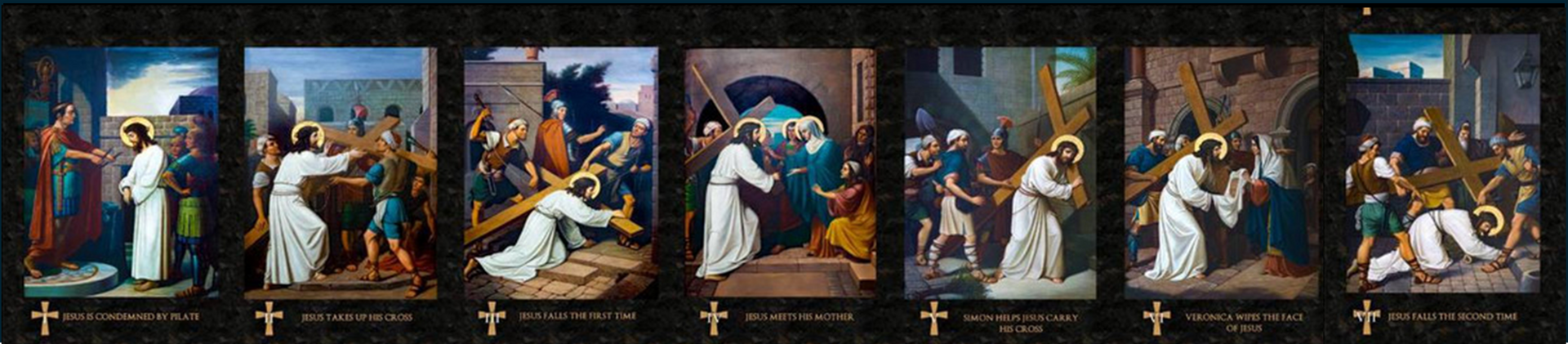
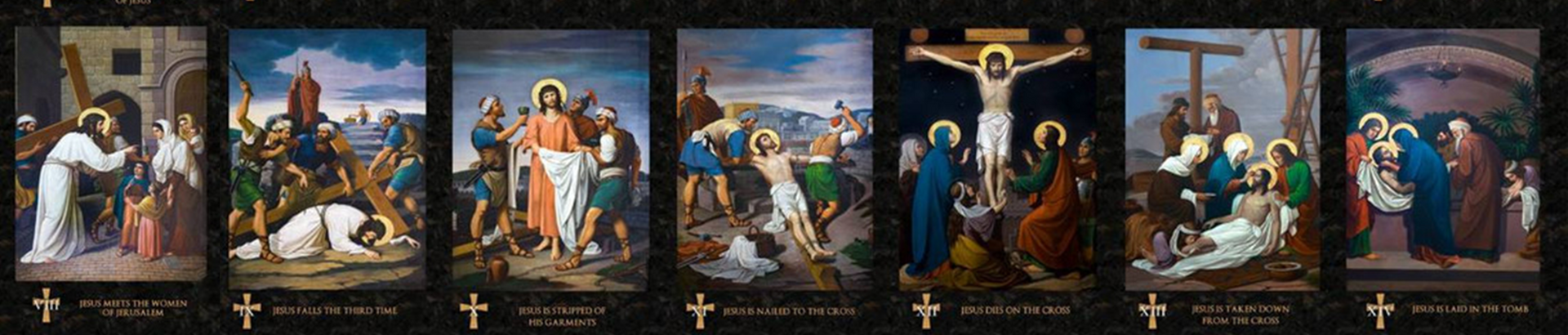
There are fourteen Stations of the Cross. Each is an invitation to contemplate and experience a pivotal moment from Jesus’ sentencing to his death to his burial. They are a powerful way to step into some of the most significant moments in human history and encounter Jesus like never before. One of the most impactful times to pray the Stations of the Cross is during Holy Week, especially on Good Friday.
For over 1000 years, Catholics have been devoted to praying the Stations of the Cross. And for over 1000 years, this deep spiritual exercise has been transforming lives. Dive into this ancient and powerful meditation on the sacrifice of Jesus and it will change your life too.
But that’s not all. Another important moment of the Chrism Mass is that every priest within the diocese renews his priestly promise. We’re also invited to pray for all priests and their ministry.
How Many Stations of the Cross Are There?
There are traditionally fourteen Stations of the Cross. Each station represents a different moment in Jesus’ Passion and Death, including:
- Jesus is Condemned to Death
- Jesus Carries the Cross
- Jesus Falls for the First Time
- Jesus Meets His Mother
- Simon Helps Jesus Carry His Cross
- Veronica Wipes the Face of Jesus
- Jesus Falls a Second Time
- Jesus Meets the Women of Jerusalem
- Jesus Falls a Third Time
- Jesus is Stripped of His Garments
- Jesus is Nailed to the Cross
- Jesus Dies on the Cross
- Jesus’ Body is Removed from the Cross
- Jesus is Laid in the Tomb
How Do I Pray the Stations of the Cross?
The Stations of the Cross is a powerful and simple way to reflect on the final moments of Jesus’ life. If you are ready to draw wisdom and inspiration from this rich prayer, there are a few options available to you.
Pray the Stations of the Cross with a group: Most Catholic churches pray the Stations of the Cross on Fridays during Lent. We encourage you to attend Stations of the Cross at your local parish. More than likely, your parish will have a depiction of each Station either inside or outside of the Church to help facilitate deeper reflection.
Pray the Stations of the Cross individually: If you can’t attend a Stations of the Cross service at your church, you can always pray them on your own. You can visit a church in your own time or even reflect from your own home.
For each station, follow the following steps:
Name the Station: The First Station is Jesus is Condemned to Death
Read the opening prayer: We adore you, O Christ, and we praise you. (Kneel) Because by your holy cross you have redeemed the world. (Rise) If you are unable to kneel, you can sit or stand.
Read the selected Scripture passage for inspiration.
Reflect and consider what this Station of the Cross means for your life.
End by praying the Our Father, Hail Mary, and Glory Be.
Repeat this process for all fourteen stations and you’ll be amazed at how the story of Jesus’ Passion impacts your day!
The First Station: Jesus is Condemned to Death
Leader: We adore you, O Christ, and we praise you. (Kneel)
Response: Because by your holy cross you have redeemed the world. (Rise)
Scripture: Mark 15:1-5, 15
And as soon as it was morning the chief priests, with the elders and scribes, and the whole council held a consultation; and they bound Jesus and led him away and delivered him to Pilate. And Pilate asked him, “Are you the King of the Jews?” And he answered him, “You have said so.” And the chief priests accused him of many things. And Pilate again asked him, “Have you no answer to make? See how many charges they bring against you.” But Jesus made no further answer, so that Pilate wondered.
So Pilate, wishing to satisfy the crowd, released for them Barab’bas; and having scourged Jesus, he delivered him to be crucified.
Prayer: Our Father…Hail Mary…Glory Be
Our Father, who art in heaven, hallowed be thy name; thy kingdom come, thy will be done, on earth as it is in heaven. Give us this day our daily bread and forgive us our trespasses, as we forgive those who trespass against us and lead us not into temptation, but deliver us from evil. Amen.
Hail Mary, full of grace, the Lord is with thee; blessed art thou among women and blessed is the fruit of thy womb, Jesus. Holy Mary, Mother of God, pray for us sinners, now and at the hour of our death. Amen. Be it done unto me according to Thy word.
Glory be to the Father, and to the Son, and to the Holy Spirit. As it was in the beginning, is now, and ever shall be, world without end. Amen.
The Second Station: Jesus Carries the Cross
Leader: We adore you, O Christ, and we praise you. (Kneel)
Response: Because by your holy cross you have redeemed the world. (Rise)
Scripture: John 19:6, 15-17
When the chief priests and the officers saw him, they cried out, “Crucify him, crucify him!” Pilate said to them, “Take him yourselves and crucify him, for I find no crime in him.”
They cried out, “Away with him, away with him, crucify him!” Pilate said to them, “Shall I crucify your King?” The chief priests answered, “We have no king but Caesar.” Then he handed him over to them to be crucified. So they took Jesus, and he went out, bearing his own cross, to the place called the place of a skull, which is called in Hebrew Gol’gotha.
Prayer: Our Father…Hail Mary…Glory Be
The Third Station: Jesus Falls for the First Time
Leader: We adore you, O Christ, and we praise you. (Kneel)
Response: Because by your holy cross you have redeemed the world. (Rise)
Scripture: John 19:1-3
And the soldiers plaited a crown of thorns, and put it on his head, and arrayed him in a purple robe; they came up to him, saying, “Hail, King of the Jews!” and struck him with their hands.
Prayer: Our Father…Hail Mary…Glory Be
The Fourth Station: Jesus Meets His Mother
Leader: We adore you, O Christ, and we praise you. (Kneel)
Response: Because by your holy cross you have redeemed the world. (Rise)
Scripture: Luke 2:34-35
[And Simeon] said to Mary:
“Behold, this child is set for the fall and rising of many in Israel,
and for a sign that is spoken against
(and a sword will pierce through your own soul also),
that thoughts out of many hearts may be revealed.”
Prayer: Our Father…Hail Mary…Glory Be
The Fifth Station: Simon Helps Jesus Carry His Cross
Leader: We adore you, O Christ, and we praise you. (Kneel)
Response: Because by your holy cross you have redeemed the world. (Rise)
Scripture: Mark 15:21
And they compelled a passer-by, Simon of Cyre’ne, who was coming in from the country, the father of Alexander and Rufus, to carry his cross.
Prayer: Our Father…Hail Mary…Glory Be
The Sixth Station: Veronica Wipes the Face of Jesus
Leader: We adore you, O Christ, and we praise you. (Kneel)
Response: Because by your holy cross you have redeemed the world. (Rise)
Scripture: Isaiah 53:2-3
He had no form or comeliness that we should look at him,
and no beauty that we should desire him.
He was despised and rejected by men;
a man of sorrows, and acquainted with grief,
and as one from whom men hide their faces
he was despised, and we esteemed him not.
Prayer: Our Father…Hail Mary…Glory Be
The Seventh Station: Jesus Falls a Second Time
Leader: We adore you, O Christ, and we praise you. (Kneel)
Response: Because by your holy cross you have redeemed the world. (Rise)
Scripture: Romans 8:31-32; 38-39
If God is for us, who is against us? He who did not spare his own Son but gave him up for us all, will he not also give us all things with him?...For I am sure that neither death, nor life, nor angels, nor principalities, nor things present, nor things to come, nor powers, nor height, nor depth, nor anything else in all creation, will be able to separate us from the love of God in Christ Jesus our Lord.
Prayer: Our Father…Hail Mary…Glory Be
The Eighth Station: Jesus Meets the Women of Jerusalem
Leader: We adore you, O Christ, and we praise you. (Kneel)
Response: Because by your holy cross you have redeemed the world. (Rise)
Scripture: Luke 23:27-31
And there followed him a great multitude of the people, and of women who bewailed and lamented him. But Jesus turning to them said, “Daughters of Jerusalem, do not weep for me, but weep for yourselves and for your children. For behold, the days are coming when they will say, ‘Blessed are the barren, and the wombs that never bore, and the breasts that never gave suck!’ Then they will begin to say to the mountains, ‘Fall on us’; and to the hills, ‘Cover us.’ For if they do this when the wood is green, what will happen when it is dry?”
Prayer: Our Father…Hail Mary…Glory Be
The Ninth Station: Jesus Falls a Third Time
Leader: We adore you, O Christ, and we praise you. (Kneel)
Response: Because by your holy cross you have redeemed the world. (Rise)
Scripture: Psalm 38:4-9
For my iniquities have gone over my head;
they weigh like a burden too heavy for me.
My wounds grow foul and fester
because of my foolishness,
I am utterly bowed down and prostrate;
all the day I go about mourning.
For my loins are filled with burning,
and there is no soundness in my flesh.
I am utterly spent and crushed;
I groan because of the tumult of my heart.
Lord, all my longing is known to thee,
my sighing is not hidden from thee.
My heart throbs, my strength fails me;
and the light of my eyes—it also has gone from me.
My friends and companions stand aloof from my plague,
and my kinsmen stand afar off.
Those who seek my life lay their snares,
those who seek my hurt speak of ruin,
and meditate treachery all the day long.
But I am like a deaf man, I do not hear,
like a dumb man who does not open his mouth.
Yea, I am like a man who does not hear,
and in whose mouth are no rebukes.
But for thee, O Lord, do I wait;
it is thou, O Lord my God, who wilt answer.
For I pray, “Only let them not rejoice over me,
who boast against me when my foot slips!”
Prayer: Our Father…Hail Mary…Glory Be
The Tenth Station: Jesus is Stripped of His Garments
Leader: We adore you, O Christ, and we praise you. (Kneel)
Response: Because by your holy cross you have redeemed the world. (Rise)
Scripture: John 19:23-24
When the soldiers had crucified Jesus they took his garments and made four parts, one for each soldier; also his tunic. But the tunic was without seam, woven from top to bottom; so they said to one another, “Let us not tear it, but cast lots for it to see whose it shall be.” This was to fulfill the scripture, “They parted my garments among them, and for my clothing they cast lots.”
Prayer: Our Father…Hail Mary…Glory Be
The Eleventh Station: Jesus is Nailed to the Cross
Leader: We adore you, O Christ, and we praise you. (Kneel)
Response: Because by your holy cross you have redeemed the world. (Rise)
Scripture: Luke 23:33-34
And when they came to the place which is called The Skull, there they crucified him, and the criminals, one on the right and one on the left. And Jesus said, “Father, forgive them; for they know not what they do.” And they cast lots to divide his garments.
Prayer: Our Father…Hail Mary…Glory Be
The Twelfth Station: Jesus Dies on the Cross
Leader: We adore you, O Christ, and we praise you. (Kneel)
Response: Because by your holy cross you have redeemed the world. (Rise)
Scripture: Luke 23:44-46
It was now about the sixth hour, and there was darkness over the whole land until the ninth hour, while the sun’s light failed; and the curtain of the temple was torn in two. Then Jesus, crying with a loud voice, said, “Father, into thy hands I commit my spirit!” And having said this he breathed his last.
Prayer: Our Father…Hail Mary…Glory Be
The Thirteenth Station: Jesus’ Body is Removed from the Cross
Leader: We adore you, O Christ, and we praise you. (Kneel)
Response: Because by your holy cross you have redeemed the world. (Rise)
Scripture: Matthew 27:57-58
When it was evening, there came a rich man from Arimathe´a, named Joseph, who also was a disciple of Jesus. He went to Pilate and asked for the body of Jesus. Then Pilate ordered it to be given to him.
Prayer: Our Father…Hail Mary…Glory Be
The Fourteenth Station: Jesus is Laid in the Tomb
Leader: We adore you, O Christ, and we praise you. (Kneel)
Response: Because by your holy cross you have redeemed the world. (Rise)
Scripture: John 19:38-40
After this Joseph of Arimathe´a, who was a disciple of Jesus, but secretly, for fear of the Jews, asked Pilate that he might take away the body of Jesus, and Pilate gave him leave. So he came and took away his body. Nicode´mus also, who had at first come to him by night, came bringing a mixture of myrrh and aloes, about a hundred pounds’ weight. They took the body of Jesus, and bound it in linen cloths with the spices, as is the burial custom of the Jews.
Prayer: Our Father…Hail Mary…Glory Be
As you end the Stations of the Cross, spend a few final minutes in quiet reflection.
Finish with the Dynamic Catholic Prayer of Transformation:
Loving Father,
Here I am.
I trust that you have an incredible plan for me.
Transform me. Transform my life.
Everything is on the table.
Take what you want to take and give what you want to give.
Transform me into the person you created me to be,
So I can live the life you envision for me.
I hold nothing back;
I am 100 percent available.
How can I help?
Amen.